Landed Cost Calculator (Excel Template)
Calculate the true landed cost of an imported shipment with this free Excel template for international trade: it adds product cost, origin charges, freight, insurance, customs duty from your own HS code rate, destination charges and bank and currency costs into one total, then returns landed cost per unit and the break-even selling price. Landed cost is the total cost of getting a product from the supplier’s factory to your warehouse, and it is the number you should price against.
Download Excel Template (.xlsx)
Free · No email required · Works in Excel and Google Sheets
What does the spreadsheet calculate?
- Adds every import cost line into one total landed cost for the shipment
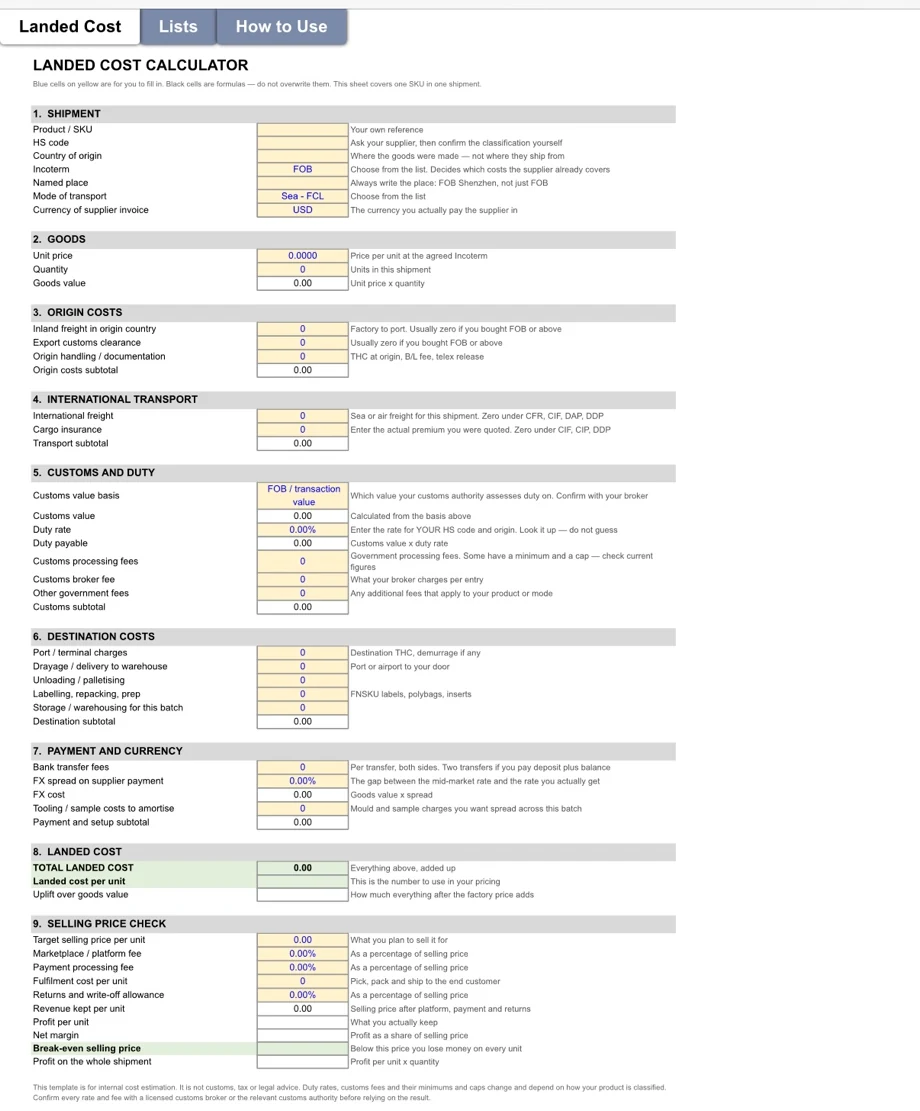
- Groups costs into nine sections: shipment, goods, origin, transport, customs, destination, payment, landed cost, selling price
- Subtotals each section so you can see where the money actually goes
- Calculates customs value from either the transaction value or the CIF value, whichever basis your authority uses
- Calculates duty payable from the duty rate you enter for your own HS code
- Returns landed cost per unit, and the uplift over the factory price as a percentage
- Returns break-even selling price after marketplace, payment and returns allowances
- Returns profit per unit, net margin, and profit on the whole shipment at any target price
What does the template look like?
The file is three sheets: a Landed Cost sheet holding all nine numbered sections, a Lists sheet holding the dropdown values for Incoterms, customs value basis and transport mode, and a How to Use sheet explaining each section. Blue cells on pale yellow are yours to fill in, black cells are formulas, and the three numbers that matter are shaded green. Nothing is hidden or password protected.
What does landed cost include?
Landed cost includes the product price plus every cost required to move, insure, clear, and deliver the goods to your warehouse. The table below lists each component, what it covers, and which party normally carries it. The last column does not give a rate or an amount: it tells you which document or authority the current figure comes from, because every one of these varies by classification, origin, carrier or bank.
| Cost Component | What It Covers | Typically Included Under | Rate or amount — where to look it up |
|---|---|---|---|
| Product cost (unit price x quantity) | The supplier invoice value of the goods themselves. | Every Incoterm. Always in landed cost. | Your supplier’s proforma invoice, at the agreed Incoterm. |
| Inland freight in origin country | Trucking from the factory to the origin port, airport, or forwarder warehouse. | Buyer pays under EXW. Seller pays under FOB and later terms. | Your origin forwarder’s written quotation for the specific factory address and container size. |
| Export customs clearance | Export declaration, export documents, and origin-side handling fees. | Buyer arranges under EXW. Seller handles from FCA and FOB onward. | The origin forwarder or export agent handling the declaration; ask for the local-charges breakdown, not a lump sum. |
| Origin handling and documentation | Terminal handling at origin, bill of lading fee, and telex release. | Usually the buyer under EXW and FOB, and inside the seller price from CFR onward. | The origin local-charges sheet from your forwarder. These are per shipment, not per unit. |
| International freight (sea or air) | Main carriage from origin port or airport to destination port or airport. | Buyer pays under EXW and FOB. Seller pays under CFR, CIF, DAP, DDP. | A dated freight quotation for your lane and equipment. Note the validity date: rates move and quotations expire. |
| Marine insurance | Cargo insurance against loss or damage in transit. | Buyer arranges under EXW, FOB, CFR. Seller buys minimum cover under CIF. | Depends on the insured value, the commodity, the route, and the cover level. Ask your cargo insurer or forwarder for the premium on your declared insured value, and check the minimum premium per shipment. |
| Import customs duty | Duty assessed on the customs value of the goods at the destination. | Buyer pays under every term except DDP. The rate is not a single number. | Depends on tariff classification and country of origin, plus any additional duties or trade programme that applies. Look your own code up in the destination tariff schedule — in the United States that is the Harmonized Tariff Schedule published by the U.S. International Trade Commission — and have a licensed customs broker confirm the classification before you rely on it. |
| Customs processing fees | Government fees charged on the entry itself, separate from duty. | Buyer pays except under DDP. | Usually a percentage of declared value with a published minimum and maximum per entry, and the percentages and the caps are revised. Take the current figures from the destination customs authority’s own published fee schedule, or from your broker’s entry summary on a previous shipment. |
| Customs broker fee | The broker who files your entry and manages classification and documents. | Buyer pays except under DDP. | A commercial charge, not a government one. Ask your broker for their written fee schedule: a base fee per entry, plus line-item charges for extra classification lines, other-agency filings, and any bond. |
| Other government fees | Additional charges that apply to your product category or transport mode. | Buyer pays except under DDP. | Depends on the commodity and the agencies that regulate it. Ask your broker which other-agency filings your HS code triggers, then take the amounts from each agency’s own published schedule. |
| Port and terminal charges | Terminal handling, container release, demurrage, detention, and chassis fees. | Split by term; the buyer pays destination-side charges under EXW through CIF. | Two sources: the destination local-charges sheet from your forwarder for the fixed items, and the terminal or carrier tariff for the free-time rules that decide whether demurrage and detention ever apply. |
| Last-mile delivery | Drayage or trucking from the destination port to your warehouse or 3PL. | Buyer pays under EXW through CIF. Seller pays under DAP and DDP. | A drayage quotation to your exact delivery postcode, including waiting time and any residential or limited-access surcharge. |
| Unloading and palletising | Devanning the container and getting the goods onto pallets at your end. | Always the buyer. Not covered by any Incoterm, including DDP. | Your warehouse or 3PL rate card, usually charged per container or per hour. |
| Labelling, repacking and prep | Marketplace labels, polybags, inserts, and any rework before the goods can be sold. | Always the buyer, and easy to leave out because it happens after arrival. | Your 3PL prep rate card, or the marketplace’s own published prep and labelling fees for the programme you use. |
| Storage for this batch | Warehousing charged against this specific shipment before it sells through. | Always the buyer. | Your warehouse rate card, multiplied by the volume and the months you expect the batch to sit. |
| Bank transfer and payment fees | Wire fees, intermediary bank fees, and payment-platform charges on supplier payments. | Always the buyer. | Your bank’s published fee schedule for outward international transfers, plus the intermediary bank deduction. Count one fee per transfer: a deposit and a balance payment are two. |
| Currency conversion spread | The gap between the interbank rate and the rate your bank actually gives you. | Always the buyer. | Do not take this from a rate table. Compare the rate you were actually given on a past transfer with the mid-market rate for that same day; the difference is your real spread. |
| Tooling and sample costs to amortise | Mould, tooling and sample charges you want spread across this batch. | Always the buyer. A one-off charge that belongs divided across the units it produced. | Your supplier’s tooling and sample invoices, divided across the units you realistically expect that tooling to produce. |
Which costs apply under each Incoterm?
The Incoterm on your purchase order decides which costs the supplier has already paid and which ones you still have to add. Costs the seller pays are inside the invoice price, so entering them again double counts them. Import duty stays with the buyer under every rule except DDP.
| Incoterm | Freight paid by | Insurance paid by | Import duty paid by | Include in your landed cost? |
|---|---|---|---|---|
| EXW (Ex Works) | Buyer | Buyer (optional, no obligation on either side) | Buyer | Yes — enter every cost line yourself, including origin inland freight and export clearance. |
| FOB (Free on Board) | Buyer (main carriage) | Buyer (optional, no obligation on either side) | Buyer | Yes — origin inland freight and export clearance sit in the supplier price; add freight, insurance, duty and destination costs. |
| CFR (Cost and Freight) | Seller | Buyer (optional, no obligation on either side) | Buyer | Yes — freight is already inside the invoice price; add insurance, duty and all destination costs on top. |
| CIF (Cost, Insurance and Freight) | Seller | Seller (minimum cover only; buyer may top up) | Buyer | Yes — freight and minimum insurance are inside the invoice price; add duty, customs fees and last-mile delivery. |
| DAP (Delivered at Place) | Seller (to the named place) | Seller bears the risk (no obligation to insure) | Buyer | Yes — transport is inside the invoice price; add duty, customs processing fees and broker fees yourself. |
| DDP (Delivered Duty Paid) | Seller | Seller bears the risk (no obligation to insure) | Seller | Yes — most costs are inside the invoice price; still add your bank fees, currency spread and any unloading you pay. |
Why are the rate cells empty?
The rate cells are empty on purpose, because no single duty rate or customs fee is correct for every importer. Three decisions in the file follow from that.
No duty rate is hardcoded anywhere in the file
Every rate and fee cell in the workbook is an empty input cell, because there is no single correct number to put there: the duty rate depends on your tariff classification and your country of origin, and customs fee percentages and caps are revised. A template that ships with a rate baked in is wrong for most of the people who download it, and quietly wrong — the total still looks confident. The How to Use sheet explains this next to the cells, so anyone else opening your file understands why those cells are blank.
The customs value basis is a dropdown, not an assumption
You choose whether duty is assessed on the transaction value of the goods or on the CIF value, and the duty formula follows your choice. Most cost spreadsheets skip this, yet it changes the duty amount directly: adding freight and insurance into the dutiable base raises the duty on the same shipment. If you are not sure which basis applies to your entry, take it from the entry summary on a shipment you have already cleared, or ask your broker.
Which cost lines to leave at zero depends on your Incoterm
The How to Use sheet maps each Incoterm to the lines you should leave empty. If you bought FOB, the origin inland freight and export clearance are already inside the supplier price, so entering them again double counts them. If you bought CIF, freight and insurance are already inside the price. Double counting and omission are the two failure modes here, and both come from the same place: not reading the cost table against the delivery term.
Costing my own first shipment
I am not writing this as a veteran importer. I am writing it as someone in the middle of it. I am preparing to ship handmade zhuni clay teaware from a workshop in Chaozhou to customers in the United States, and I built this calculator because I needed to know whether the numbers worked before I committed. Everything below came out of costing that shipment. Where I do not know something yet, I have said so rather than filled the gap.
A duty-inclusive quote still has duty inside it
My forwarder quotes a flat $30 per set, direct mail from China, door to door, with duty included. For a while I treated that as a single shipping line and moved on.
That was the mistake. Tax-included does not mean there is no duty. It means the duty is inside someone else’s number and I cannot see it. I have no entry of my own, no classification I chose, and no way to check whether the rate applied was right for my product. If it was wrong in my favour, that is my exposure, not the forwarder’s.
This is why the calculator keeps duty on its own line even when your quote bundles it. If you are quoted duty-inclusive, enter the whole amount on one line and write next to it that duty is inside. At least then you know which number to ask about when it moves.
Freight is a percentage, not an amount
The same $30 lands very differently depending on what it is carrying.
My semi-handcrafted pots cost about $10 each from the maker. Add $30 of shipping and the landed cost is around $40. My fully hand-thrown pots cost about $50. Add the same $30 and the landed cost is around $80.
On the cheaper pot, shipping is three times the product cost. On the more expensive one, it is around half. Those are not the same business. One of them can absorb an advertising budget and one of them cannot, and I could not see that until I put both through the same sheet.
If you sell more than one price tier, run each tier separately before you decide what to promote. A shipping cost that is fine on your best product can quietly remove the margin from your cheapest one.
A quote is a snapshot of the rules on the day you asked
That $30 was priced against the rules in force when I asked for it. Those rules have already changed once during the period I have been planning this, and low-value parcels into the United States are not treated the way they were a couple of years ago.
I do not publish what the current treatment is, because it moves and because it depends on the goods. What I now do is different: I write the date next to every quote in my cost sheet, and I treat any figure older than a few weeks as an estimate rather than a number.
The practical version of this is simple. Ask your forwarder two questions in writing. What is inside this price. And what happens to it if the rules change.
Per-parcel shipping and one bulk entry are different cost shapes
I chose direct mail per order because I am starting small and I did not want inventory sitting in a warehouse before I know what sells. That is a real trade-off, not a default.
Shipping each order individually means paying the border cost once per parcel, every time, forever. Importing in bulk means paying it once on the whole batch, then shipping domestically. The per-unit number can differ substantially between the two, and the crossover point depends on your volume, your unit value and your storage cost.
The calculator handles one shipment at a time, so the way to compare these is to run it twice: once with per-parcel costs on a single unit, and once with bulk costs divided across the batch. Do it before you commit to a fulfilment model, not after.
What I do not know yet
I have not yet cleared a bulk container entry into the United States, so I have not personally paid a broker fee, a terminal charge, or a customs processing fee. Those lines are in the calculator because they belong in a complete landed cost, not because I have receipts for them.
I am saying that plainly because a costing tool is only as good as the person’s honesty about its limits. When I have run that entry myself, I will update this section with what the numbers actually were.
If you have cleared one and something on this page does not match your experience, tell me and I will correct it.
Why this calculator asks you to enter your own rates
Import costs change by product, country, shipment, broker, bank and route. This template deliberately avoids hard-coding duty rates and current fees. Where a figure can change, the spreadsheet gives you a place to enter the real number for your shipment.
Calculate the shipment before you place the order.
Download the Free Landed Cost Calculator Excel
Free · No email required · No signup · Downloads directly as an .xlsx file
How do you use the spreadsheet?
Fill the Landed Cost sheet from section 1 down to section 7, then read the three green results in sections 8 and 9. The steps below take about ten minutes for a first shipment.
- In section 1, enter the SKU, the HS code, the country of origin, the mode of transport, and the Incoterm with its named place; the Incoterm decides which of the later costs the supplier has already paid.
- In section 2, enter the supplier unit price at the agreed Incoterm and the units in this shipment; the sheet returns the goods value.
- In section 3, enter inland freight to the port, export clearance, and origin handling and documentation; these are usually zero if you bought FOB or above.
- In section 4, enter international freight and the cargo insurance premium you were actually quoted, leaving a line at zero only when the supplier has already paid it.
- In section 5, choose whether your authority assesses duty on the transaction value or the CIF value, then enter the duty rate for your own HS code and origin along with customs processing fees, broker fee, and any other government fees.
- In section 6, enter port and terminal charges, drayage to your warehouse, unloading, labelling and prep, and any storage charged against this batch.
- In section 7, enter bank transfer fees for every transfer you make, the exchange-rate spread on the supplier payment, and any tooling or sample charges you want amortised across the batch.
- Section 8 returns total landed cost, landed cost per unit, and the uplift over the factory price; enter a target selling price and your marketplace, payment and returns percentages in section 9 to see profit per unit, net margin, and the break-even selling price.
Frequently asked questions
What is landed cost?
Landed cost is the total cost of getting a product from the supplier's factory to your warehouse, including the product price, freight, insurance, customs duty, customs processing fees, and last-mile delivery. It is the number you should price against, because it is what the unit actually cost you once it is on your shelf. Anything you pay to move, insure, clear, or deliver the goods belongs in it.
What is the difference between landed cost and COGS?
Landed cost is the full cost of acquiring inventory and getting it into your warehouse, while cost of goods sold is the accounting figure recognized when that inventory is sold. In practice the landed cost per unit becomes the inventory carrying value, and that value flows into COGS at the moment of sale. The difference is timing and purpose: landed cost is a purchasing and pricing number, COGS is a reporting number.
Is customs duty part of landed cost?
Yes, import duty is part of landed cost whenever you are the party that pays it. Under most Incoterms the buyer pays import duty; under DDP the seller pays it and it is already inside the price you were quoted. Duty rates depend on tariff classification, country of origin, and any trade program that applies, so confirm the rate for your specific product before you rely on it.
Does landed cost include VAT or sales tax?
Recoverable taxes should be excluded from landed cost, and non-recoverable taxes should be included. If you can reclaim import VAT as an input credit, it is a cash-flow item rather than a cost, so leaving it in overstates your unit cost. If you cannot reclaim it, it is a real cost of acquiring the goods and belongs in the total. Confirm recoverability with your accountant for your registration and jurisdiction.
How do I calculate landed cost per unit with multiple SKUs?
Allocate each shipment-level cost across the SKUs using a consistent driver, then add each SKU’s own direct costs. Freight and terminal charges are usually allocated by volume or weight, while duty is calculated per SKU because rates differ by classification. Pick one allocation driver and apply it to every shipment so your unit costs stay comparable over time. This template covers a single SKU; for a mixed container, copy the sheet per SKU and allocate the shared lines first.
What is the difference between FOB and CIF for landed cost?
Under FOB you pay international freight and insurance yourself, so those lines are separate entries in your landed cost calculation. Under CIF the seller has already paid freight and arranged minimum cargo insurance, so those amounts are inside the invoice price and you must not enter them a second time. Under both terms you still pay import duty, customs fees, and last-mile delivery.
What duty rate should I enter in the template?
Enter the rate for your own tariff classification and country of origin, taken from the destination tariff schedule rather than from a template. In the United States that schedule is the Harmonized Tariff Schedule published by the U.S. International Trade Commission, and additional duties may apply on top of the general rate depending on the origin and the product. Classification is the part that goes wrong most often, so have a licensed customs broker confirm the code before you rely on the figure. The template deliberately ships with that cell empty for this reason.
Why does the template not include any duty rates or customs fees?
Because there is no single correct figure to include: duty depends on classification and origin, customs fee percentages and their minimums and caps are revised, broker fees are commercial, and bank spreads differ per bank. Any number printed into a template is wrong for most of the people who download it, and wrong in a way that still looks confident once the total calculates. Instead, every rate cell is an input, and the cost table on this page tells you which document or authority the current figure comes from.
Can I use this template in Google Sheets?
Yes, the file opens in Google Sheets through File then Import, and every formula it uses is supported there. It contains no macros, no add-ins, and no external data connections, so nothing breaks on import. It also opens in LibreOffice Calc and Numbers, though column widths may need adjusting.
How accurate is a landed cost estimate?
A landed cost estimate is only as accurate as the duty rate, freight quote, and exchange rate you enter, and the largest errors usually come from classification and from fees discovered after arrival. Freight quotes expire, demurrage and detention appear late, and the exchange rate you actually receive differs from the interbank rate. Rerun the calculation with final invoice figures after the shipment clears, and compare it with your estimate to see where your assumptions drift.
Who wrote this?
Lao Luo
Sourcing handmade teaware from Chaozhou and selling it to US customers. Building these templates while doing it.
The templates and calculators on this site are for internal cost estimation. They are not customs, tax, or legal advice. Where a calculator shows a pre-filled duty rate it is an editable, dated default chosen to illustrate the calculation, not a determination of your duty. Rates and fees change and vary by product classification and origin. Confirm every figure with the official tariff schedule, a licensed customs broker, or the relevant customs authority before relying on it.
Quoting a buyer rather than costing a purchase? Use the proforma invoice template for that.
Last updated: August 12, 2026. Delivery terms on this page follow Incoterms 2020, the rules in force in 2026.
Related Guides
- The Landed Cost Formula, Explained Line by Line — every bucket in the formula, with two worked examples from China to the US.
- How to Calculate Import Duty and Tariffs — find your HTS code, set the customs value, and add the federal fees most importers miss.
- How to Allocate Freight Costs Across SKUs — three methods compared on the same shipment, and how to pick the right one.
- DDP vs FOB vs EXW: A Real Cost Comparison — the same order quoted three ways, showing which term actually costs less.
- 11 Hidden Import Costs That Wreck Your Margins — chassis fees, demurrage, FX spread, and the rest of the invoice nobody quotes you.