Proforma Invoice Template (Excel)
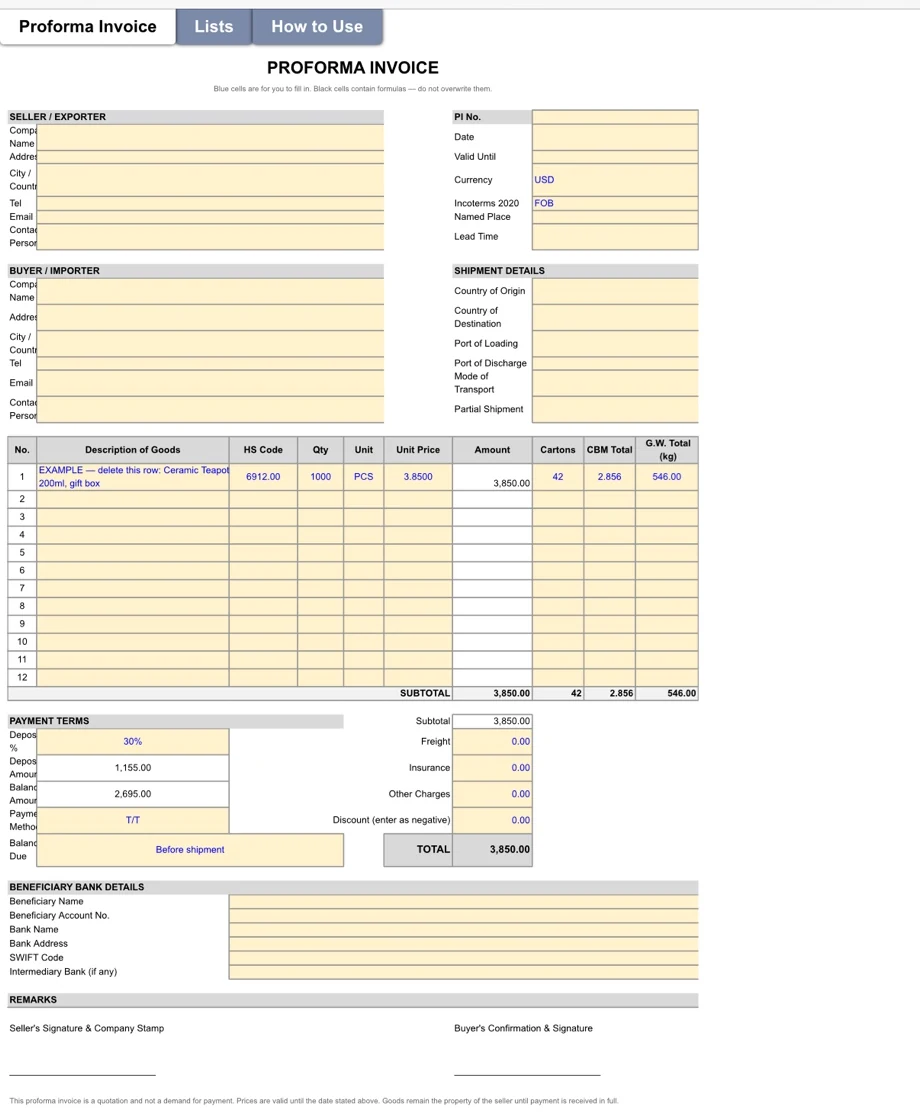
Create a professional proforma invoice for international trade with this free Excel template: it carries an HS code and country of origin on every goods line, an Incoterms 2020 rule with its named place, cartons, CBM and gross weight, and it auto-calculates line amounts, the invoice total, and the deposit and balance from the deposit percentage you set. A proforma invoice is a quotation issued in invoice format, sent before production so the buyer can confirm the order, arrange payment, apply for an import licence, or open a letter of credit.
Download Excel Template (.xlsx)
Free · No email required · Works in Excel and Google Sheets
What does the template do?
- Lays out seller, buyer, shipment and payment blocks in the order a buyer expects to read them
- Calculates the amount on each of twelve goods lines from quantity and unit price
- Totals the goods lines, cartons, CBM and gross weight into one subtotal row
- Adds freight, insurance, other charges and a discount line to reach the invoice total
- Splits the total into a deposit and a balance from the deposit percentage you set
- Supplies dropdown lists for Incoterms 2020, unit, currency and mode of transport
- Holds beneficiary bank details, SWIFT code and intermediary bank in one block
- Prints to one page wide on A4 or US Letter, with signature lines for both parties
What does the template look like?
The file is three sheets: a Proforma Invoice sheet you fill in and print, a Lists sheet holding the dropdown values for Incoterms, unit, currency and mode of transport, and a How to Use sheet explaining each block. Blue cells on pale yellow are yours to fill in; black cells are formulas. Nothing is hidden or password protected.
What should a proforma invoice include?
A proforma invoice should carry enough detail for the buyer to price the landed cost, book freight, and instruct their bank without asking you a follow-up question. The table below lists the fields in this template and why each one is there. This page states no rates, fees or amounts, because those depend on your product, your classification and your negotiation.
| Field | What it is | Why it matters |
|---|---|---|
| PI number and date | Your own reference for the quotation and the day you issued it. | The buyer quotes this number back when they confirm the order and when they instruct their bank, so a missing reference slows the payment down. |
| Valid until | The date the quoted prices expire. | Without an expiry date an old quotation can be held against you after material costs or the exchange rate have moved. |
| Currency | The currency of every figure on the invoice, chosen from a dropdown list. | The buyer arranges payment in this currency, and the currency decides who carries the exchange-rate movement between quotation and payment. |
| Incoterms 2020 and named place | The delivery rule chosen from a dropdown, plus the place it applies to. | The rule decides which costs are already inside your price. An Incoterm without a named place is incomplete: write FOB Shenzhen, not FOB. |
| Lead time | Production and readiness time after the deposit clears. | The buyer plans their inbound freight booking and their own selling season around this figure. |
| HS code per line | The tariff classification of each product line. | The buyer needs it to estimate duty before committing. A wrong code means the buyer budgets the wrong duty rate. |
| Country of origin and destination | Where the goods were made, and where they are going. | Origin drives duty assessment, origin marking, and eligibility for any trade programme, and it is not the same as the port you ship from. |
| Port of loading and port of discharge | The named origin and destination ports or airports. | These two fields, with the mode of transport, are what a freight forwarder needs before they can quote. |
| Partial shipment | Whether the order may ship in more than one consignment. | It matters a great deal under a letter of credit, where an unstated allowance can cause the documents to be rejected. |
| Cartons, CBM total and gross weight | Packing quantity, volume and weight, totalled across the goods lines. | The buyer cannot obtain a freight quote without volume and weight, so leaving them blank stalls the whole booking. |
| Deposit percentage, deposit and balance | The share of the total payable up front; the two amounts calculate themselves. | Deposit terms are the part of a quotation buyers negotiate hardest, so state them in figures rather than words. |
| Beneficiary bank details and SWIFT code | Account name, account number, bank name and address, SWIFT, and any intermediary bank. | A single wrong character in the SWIFT code returns the transfer days later, minus fees. Check it character by character. |
What is the difference between a proforma invoice and a commercial invoice?
A proforma invoice is issued before production as a binding quotation, while a commercial invoice is issued after the goods are ready and is the document customs assesses duty on. The two are not interchangeable, and sending the wrong one to a broker is a common cause of delay at the border.
| Aspect | Proforma invoice | Commercial invoice |
|---|---|---|
| When it is issued | Before payment and before production, as part of the quotation stage. | After the goods are made and ready to ship. |
| What it is for | Lets the buyer confirm the order, arrange payment, apply for an import licence, or open a letter of credit. | Bills the buyer for goods already produced, and evidences the transaction value. |
| Is it binding | A binding quotation for the period stated in Valid Until. Amounts may still change. | The final billing document. Amounts are settled. |
| Used for customs clearance | No. Presenting a proforma invoice for clearance is one of the most common causes of shipment delays. | Yes. Customs uses it to assess duty and taxes on the entry. |
| Payment status | Not a demand for payment. It states terms rather than claiming a debt. | A demand for payment against agreed terms. |
| Signatures | Seller's signature and stamp, plus the buyer's confirmation signature. | Seller's signature; buyer confirmation is not usually part of the document. |
How do you fill in the template?
Work down the sheet from the seller block to the bank block, then check the print preview before you send it. The steps below take about ten minutes for a first quotation.
- Enter the full registered company name, address, telephone, email and contact person for both the seller and the buyer.
- Enter the PI number, the issue date, and the Valid Until date so the quoted prices have a clear expiry.
- Pick the currency and the Incoterms 2020 rule from the dropdown lists, then type the named place next to the rule.
- Enter country of origin, country of destination, port of loading, port of discharge, mode of transport, and whether partial shipment is allowed.
- Delete the example row, then enter a description, HS code, quantity, unit, unit price, cartons, CBM and gross weight on each line; the amount column calculates itself.
- Enter freight, insurance, any other charges, and a discount as a negative number; under EXW and FOB the freight and insurance lines are usually zero, and under CIF and DDP they belong on the invoice.
- Enter the deposit percentage, the payment method and when the balance is due, then check the deposit and balance amounts the sheet returns.
- Fill the beneficiary bank details, verify the SWIFT code character by character, review the print preview at one page wide, and export to PDF before sending.
Frequently asked questions
What is a proforma invoice?
A proforma invoice is a quotation issued in invoice format, sent before production and before payment. It states the goods, quantities, prices, delivery terms and payment terms so the buyer can confirm the order, arrange the transfer, apply for an import licence, or open a letter of credit. It is not a demand for payment and it does not record a completed sale.
What is the difference between a proforma invoice and a commercial invoice?
A proforma invoice is issued before production as a binding quotation, while a commercial invoice is issued after the goods are ready and is the final billing document. Customs assesses duty on the commercial invoice, not the proforma. Presenting a proforma invoice for customs clearance is one of the most common causes of shipment delays.
Can a proforma invoice be used for customs clearance?
No, customs clearance requires a commercial invoice. The proforma invoice belongs to the quotation and payment stage; the commercial invoice reflects the goods that actually shipped and the value the entry is assessed on. Sending the proforma to your broker instead of the commercial invoice will hold the entry up.
Is a proforma invoice legally binding?
A proforma invoice binds the seller to the stated prices and terms for as long as the Valid Until date allows, but it does not by itself create an obligation for the buyer to pay. That is why the validity date matters: once it passes, you are free to requote. Many buyers treat a signed proforma invoice as the order confirmation, so the terms on it should be the terms you can actually honour.
What should a proforma invoice include?
A proforma invoice should include seller and buyer details, a PI number and date, a validity date, the currency, the Incoterms 2020 rule with its named place, a goods table with descriptions, HS codes, quantities, unit prices and amounts, packing volume and weight, the invoice total, payment and deposit terms, beneficiary bank details, and both signature blocks. The fields buyers most often find missing are the HS code, the country of origin, the validity date, the named place, and the CBM and gross weight.
Do I need to put freight and insurance on a proforma invoice?
It depends on the Incoterm you quoted. Under EXW and FOB the buyer arranges and pays for the main carriage, so those lines are normally zero on your invoice. Under CFR, CIF, DAP and DDP the seller has already committed to those costs, so they belong on the invoice — either inside the unit price or on the separate freight and insurance lines, but never in both places.
How do I add more lines to the goods table?
The table has twelve lines. To add more, right-click a row number inside the table and choose Insert; the amount formula and the subtotal range extend automatically. Do not insert rows below the subtotal row, because those rows fall outside the totalled range.
Can I use this proforma invoice template in Google Sheets?
Yes, the file opens in Google Sheets through File then Import with the Replace spreadsheet option, and the dropdown lists and formulas carry over unchanged. It contains no macros, no add-ins and no external data connections. It also opens in LibreOffice Calc and Numbers, though column widths may need adjusting before printing.
Who wrote this?
Lao Luo
Sourcing handmade teaware from Chaozhou and selling it to US customers. Building these templates while doing it.
The templates and calculators on this site are for internal cost estimation. They are not customs, tax, or legal advice. Where a calculator shows a pre-filled duty rate it is an editable, dated default chosen to illustrate the calculation, not a determination of your duty. Rates and fees change and vary by product classification and origin. Confirm every figure with the official tariff schedule, a licensed customs broker, or the relevant customs authority before relying on it.
Working out what the goods will actually cost you once they arrive is a separate job — use the landed cost calculator for that.
Last updated: August 12, 2026. Delivery terms on this page and in the template follow Incoterms 2020, the rules in force in 2026.