Incoterms® 2020 Chart
Who pays, who carries the risk, and the exact moment it changes hands — all eleven rules on one page. Download the chart as a one-page PDF for printing, or as an image for a training deck or a supplier email.
Free · No email required · Prints on A4 or US Letter · PNG version
Is there an Incoterms 2026 edition?
No. The International Chamber of Commerce has not published one. Incoterms® 2020 took effect on 1 January 2020 and is still the current edition; the ICC revises the rules roughly once a decade, so the next edition is expected around 2030.
A contract signed today should name the edition explicitly, like this: FCA Shenzhen Port, Incoterms® 2020. A quotation that says only “FOB”, or one that cites a rulebook that does not exist, leaves the delivery term open to argument.
The chart
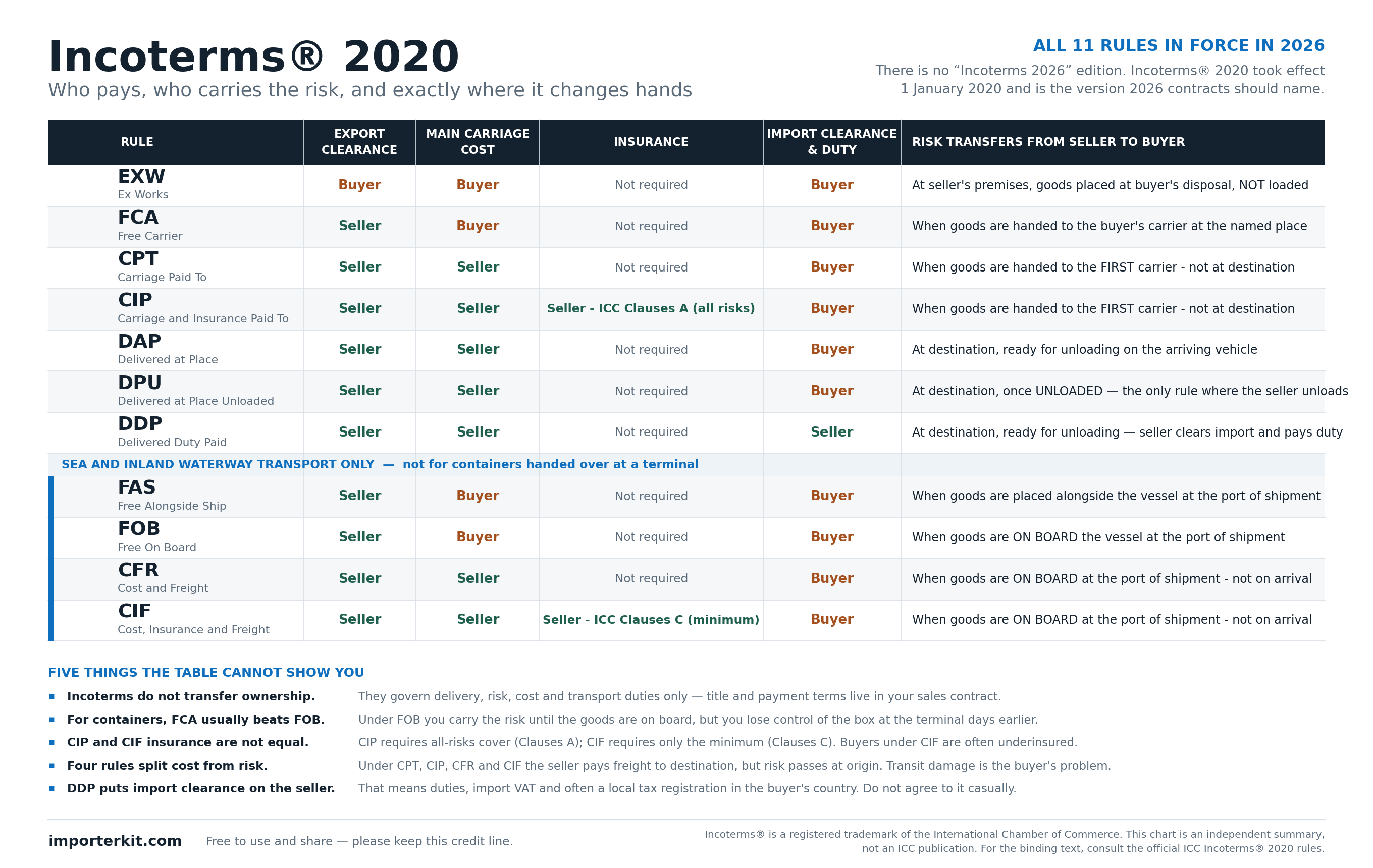
The 11 rules
Seven rules work for any mode of transport. Four are written for sea and inland waterway carriage, and are the wrong choice for containers handed over at a terminal.
| Rule | Export clearance | Main carriage cost | Insurance | Import clearance & duty | Risk transfers from seller to buyer |
|---|---|---|---|---|---|
| EXW Ex Works | Buyer | Buyer | Not required | Buyer | At the seller’s premises, once the goods are placed at the buyer’s disposal — not loaded. |
| FCA Free Carrier | Seller | Buyer | Not required | Buyer | When the goods are handed to the buyer’s carrier at the named place. |
| CPT Carriage Paid To | Seller | Seller | Not required | Buyer | When the goods are handed to the first carrier — not on arrival. |
| CIP Carriage and Insurance Paid To | Seller | Seller | Seller — Clauses A (all risks) | Buyer | When the goods are handed to the first carrier — not on arrival. |
| DAP Delivered at Place | Seller | Seller | Not required | Buyer | At the named destination, ready for unloading on the arriving vehicle. |
| DPU Delivered at Place Unloaded | Seller | Seller | Not required | Buyer | At the named destination, once unloaded — the only rule that puts unloading on the seller. |
| DDP Delivered Duty Paid | Seller | Seller | Not required | Seller | At the named destination, ready for unloading — the seller has already cleared import and paid the duty. |
| Sea and inland waterway transport only | |||||
| FAS Free Alongside Ship | Seller | Buyer | Not required | Buyer | When the goods are placed alongside the vessel at the named port of shipment. |
| FOB Free On Board | Seller | Buyer | Not required | Buyer | When the goods are on board the vessel at the port of shipment. |
| CFR Cost and Freight | Seller | Seller | Not required | Buyer | When the goods are on board at the port of shipment — not on arrival. |
| CIF Cost, Insurance and Freight | Seller | Seller | Seller — Clauses C (minimum) | Buyer | When the goods are on board at the port of shipment — not on arrival. |
Five things the table cannot show you
- Incoterms do not transfer ownership. They allocate delivery, risk, cost and transport duties. Title, payment terms and remedies for breach live in the sales contract and in the law that governs it.
- For containers, FCA usually beats FOB. Under FOB you keep the risk until the goods are on board, but at a container terminal you lose physical control days earlier. FCA moves the transfer point to where control actually changes.
- CIP and CIF insurance are not the same cover. CIP obliges the seller to buy all-risks cover (Institute Cargo Clauses A). CIF obliges only the minimum (Clauses C). Buyers who read CIF as “insured” are often underinsured.
- Four rules split cost from risk. Under CPT, CIP, CFR and CIF the seller pays freight all the way to the destination, but risk passes back at origin. Damage in transit is the buyer’s problem even though the seller booked the ship.
- DDP moves import clearance onto the seller. That means duty, import VAT, and in some countries a local tax registration the seller may not be able to obtain. It is the most commonly agreed and most commonly regretted rule.
What each rule actually costs
The table above shows who is responsible for what. It does not show what that responsibility costs you. We quoted the same shipment under EXW, FOB and DDP and compared the real totals — the cheapest quote was not the cheapest outcome. See DDP vs FOB vs EXW: a real cost comparison.
How to write it so it holds up
A rule on its own is incomplete. Three parts belong together: the rule, the named place, and the edition — for example CIF Rotterdam, Incoterms® 2020, or DAP 14 Rue de Lyon, Paris, Incoterms® 2020.
Name the place as precisely as the rule allows. Under the D rules the named place is where delivery happens, so vagueness there is expensive. Under FCA, FOB and the other origin rules the named place decides where your risk ends, and a port name and a terminal name are not the same thing.
Questions
Is there an Incoterms 2026 edition?
No. Incoterms® 2020 is the current edition and remains in force through 2026. The International Chamber of Commerce revises the rules roughly once a decade, so the next edition is expected around 2030. A contract signed in 2026 should cite Incoterms® 2020.
How many Incoterms rules are there?
Eleven. Seven work for any mode of transport (EXW, FCA, CPT, CIP, DAP, DPU, DDP) and four are written for sea and inland waterway carriage only (FAS, FOB, CFR, CIF).
What is the difference between FOB and FCA?
Both pass risk at origin, but at different moments. FOB passes risk when the goods are on board the vessel. FCA passes risk when the goods are handed to the carrier at the named place. For containerised cargo delivered to a terminal, FCA reflects what actually happens; FOB leaves the seller carrying risk over goods it no longer controls.
Can I still use Incoterms 2010?
Yes, if both parties agree and the contract states which edition applies. Editions are not automatically superseded. What causes disputes is naming no edition at all.
Which rule is safest for a first-time importer?
FCA or CPT at a named origin point gives you control of the main carriage without the seller’s freight margin, and keeps import clearance with your own customs broker. EXW pushes export clearance onto a buyer who often cannot legally perform it; DDP pushes import obligations onto a seller who often cannot either.
Using this chart
Print it, put it in a training deck, send it to a customer, or post it on your own site. No permission needed and no fee. The only thing asked in return is a visible credit line — Chart by ImporterKit, importerkit.com — linked if the format allows.
Incoterms® is a registered trademark of the International Chamber of Commerce. This chart and page are an independent summary prepared by ImporterKit; they are not an ICC publication and are not endorsed by the ICC. The binding text is the official ICC Incoterms® 2020 rules.
Last updated: August 17, 2026. The rules shown are Incoterms® 2020, the edition in force in 2026.